Custom websites
An engineer checking a shop out before handing over a spec wants proof of range fast: portal frames, staircases, mezzanine work, sorted so a job type is easy to find, not buried in a generic gallery.
How we build theseA structural steel job starts as a drawing, and that drawing sets a permitted band around every dimension it names, not just a target figure. The engineer or builder holding it isn't weighing up whether your business feels trustworthy. They're asking whether the shop can read that drawing and hold what it specifies. A member outside its band doesn't get touched up on site: it's rejected and cut again from new steel, on the shop's own time, with nothing to sell the failed piece to on the next job.
That's real money on both ends of this trade's range: a $5,000 staircase or balustrade and a $150,000 portal frame package fail the same way once a member is out of tolerance, and neither absorbs a re-fabrication for free. We build for fabricators supplying Geelong's new industrial estates through to Melbourne renovations and small commercial fit-outs, on the one job this trade's website actually has to do: make it obvious, fast, that the shop reads a drawing correctly.
Get a free quote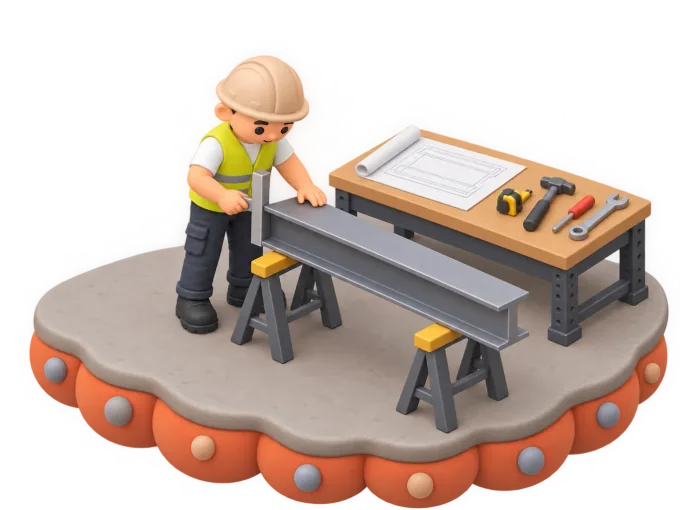
No photograph or star rating proves a shop can do this. Only the finished member, measured against the drawing that specified it, does.
The dimension the drawing actually specifies
One reading out of tolerance is the whole risk this trade carries. The stringer above isn't packed out on site to compensate: it goes back to the shop and is re-fabricated from new steel, at the shop's own cost, on a bespoke item nobody else's job can use. That single rejected member can erase the margin the other three correctly fabricated ones actually earned.
Nothing here assumes a homeowner is the one weighing you up.
An engineer checking a shop out before handing over a spec wants proof of range fast: portal frames, staircases, mezzanine work, sorted so a job type is easy to find, not buried in a generic gallery.
How we build theseThis trade's own search volume is genuinely thin, and we say so rather than sell around it: the real value here is showing up correctly when a project manager sourcing multiple quotes does look, suburb by suburb.
SEO and local searchA profile clearly still active, updated with recent completed work, reads as a shop still trading and capable. One untouched for a year reads as a risk nobody wants to put a tender in front of.
Google Business Profile managementA quote that goes quiet while a project's finalising trades is the real leak here, not a missed call. Follow-ups run on their own schedule so a genuine enquiry doesn't go cold waiting on someone to remember it.
How the automation worksA re-fabricated member is what actually erodes a quoted job's margin, not a missed enquiry. Quotes go out priced against what the last comparable job really took, material and rework included, and invoicing follows straight through.
Back office supportThis trade has no emergency half and no genuine weather season. Cutting, welding and assembling structural steel runs under cover, on a builder's project programme, months ahead of when the steel actually goes up on site. A member either gets fabricated to spec on that programme's own timeline or it doesn't, and nothing about the calendar decides which.
That isn't a regulator's page staying quiet on the subject. It's a checked absence across the complete list of every commercial and domestic class of registered builder the state recognises, not a shortlist of the obvious ones.
One steel-related class does exist on that same list, and it covers something else entirely: managing the on-site erection of steel someone else already fabricated, not the shop-based cutting, welding and assembly this trade actually does. That's why this finding says "not licensed to fabricate," never "not regulated at all." The next section covers what still governs the work.
Named directly by Parliamentary Counsel Victoria, Building Regulations 2018 (Vic), primary Victorian legislation. Verified 31 August 2026.
"Not licensed" answers one question only. It says nothing about what the finished steel has to meet, who's certified to weld it, or who needs a licence to lift it into place.
Published by WorkSafe Victoria, the state's work-safety regulator. Verified 31 August 2026.
Every one of these is something we commit to, not a sales line.
Your own ABN is what registers everything from day one: the web address, the build, the Google listing. Walk away whenever you like, and there's genuinely nothing left here for us to hand back.
Nothing here is a fixed contract that quietly renews itself. It's month to month, and a written notice closes it out, without a cancellation charge on either side.
This trade's own search volume genuinely sits at the floor of everything we've checked, because the work is sold to engineers and builders, not found on Google. What we build holds up the moment one of them looks the business up, never a promise that a website becomes a lead-generation engine this trade's buyers were never going to use.

A member that misses its tolerance isn't repaired: it's re-fabricated from new steel, on the shop's own time, with nothing to sell the failed piece to on another job. A $5,000 staircase and a $150,000 structural package absorb one re-fabricated member completely differently, so it's worth running the real figures rather than guessing at what one rejection actually costs.
 Job profitability calculator
Delta Infotech Pty Ltd has traded since 2021, from a street address anyone can look up in the time it takes to shortlist a supplier for a tender.
Because the number in someone's phone doesn't answer for you the first time a new engineer or builder looks the business up. A website here isn't there to manufacture search traffic this trade was never going to get at scale. It's there for the moment someone new checks the business out before handing over a spec: recent finished work, and nothing that reads like it's sat untouched for a year.
It can't hold a tolerance for you, and we won't pretend a website replaces the shop's own quality control. What it can do is get out of the way fast: show the range and scale of work the shop actually does, so an engineer sizing up whether to send you the drawing at all isn't stuck guessing from nothing.
Yes, stated precisely rather than vaguely. A standard or a certification scheme isn't a trade licence, and this trade doesn't need one to operate. Naming exactly what's certified does more for a specifying engineer than a general "fully accredited" line ever will.
Because this trade doesn't lose money to a missed phone call. It loses money to a rejected member re-fabricated from new steel at the shop's own cost, on a job that was already quoted. That's the specific failure the calculator below is built to catch, not a generic add-on carried over from a different trade's problem.
Your own ABN, from day one. The domain, the site and the listing never sit under Delta's name, so there's nothing to chase back if you move on.
No. It runs month to month, and a note in writing ends it whenever suits, no exit fee attached.
A footing gets excavated and poured before a single column stands on it. A masonry wall often carries straight over a steel lintel once it's in.
Footings and pads get dug out before a portal frame column ever stands on them, one trade's tolerance setting the ground the next one has to build square against.
See the excavation contractor pageA base plate bolts to a slab or footing a concreter poured weeks earlier, and the steel above it is only as square as that pour turned out to be.
See the concreter pageA steel lintel often carries a full course of masonry above an opening, the two trades' own tolerances stacking on the same span whether either one notices or not.
See the bricklayer pageCall, or fill in the enquiry form below with whatever the business runs online today. An engineer sizing up a new supplier is exactly the read we'll give it back to you, honestly, before you spend a cent closing any gap it finds.
Built the same way for a fabricator running steel out of Geelong or supplying a renovation in Melbourne: the drawing decides the job, not the postcode.