Skip to content
Delta Infotech
+61 470 344 729
Plasterers · Victoria

The builder hires the plasterer. Not a search result.

Most plastering work is handed down, not searched for. A builder or a renovation head contractor scopes the job, books the trades and rings whoever they already trust, or whoever's name just got passed to them on-site (sheet lining before the paint goes on, a render job slotted into someone else's programme). The person living in the finished room is rarely the one who found you, and rarely the one deciding whether you get the next call.

That doesn't mean nobody searches. Someone chasing a cracked ceiling or a small render job still types it into Google, and we build for that half too. But the bigger half of this trade is won or lost on whether the site holds up the moment a builder actually looks you up: recent work, a business that's clearly still trading, nothing that reads like it hasn't been touched in a year. We build for plasterers working Geelong's new estates through to Melbourne's older rendered terraces, for the job that gets searched and the one that gets handed down the chain.

Get a free quote
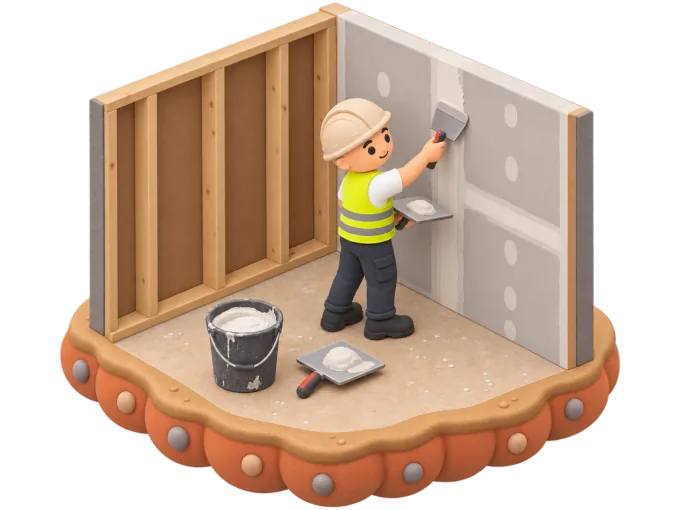
An isometric clay-style diorama of a plasterer applying a skim coat to an interior wall with a trowel and hawk, a bucket of mixed plaster and a bag of gyprock screws at his feet
The whole argument

Most plastering work arrives through someone else's phone

Two very different amounts of work reach the same plastering business, and only the smaller one ever runs through a search.

Handed to you by a builder or renovation head contractor, already scoped and slotted into their programme
Found directly, off a search for a plasterer or a render job
You

Every trade this project has measured carries a cluster of business owners searching for marketing help online, from under a hundred to several hundred a month. Plastering's cluster is the smallest of the lot, by roughly a factor of ten, and that gap isn't a weakness in the research, it's the finding. A trade mostly found through whoever's already running the job has less reason to go looking for a website itself. The thin lane above is real too: it's what the local search work below is built for, just never the bulk of this trade's work.

What we build

Five things built for how plastering work actually arrives

Nothing here assumes a homeowner is the one deciding whether you get the job.

Custom websites

The first thing a builder actually does before handing you a job is open your site or your Google listing on their phone, mid-conversation, to check you're real. Recent finished work, a number that's tappable without a second tap, nothing that looks abandoned. That's the whole test, and most plastering sites fail it by looking untouched since the day they went up.

How we build these

Local SEO for plasterers

Rendering near me and gyprock near me are real searches with real volume, smaller than the builder channel but real, and each one gets its own page rather than a shared paragraph. Built around what a homeowner actually types for a render job or a ceiling repair, suburb by suburb.

SEO and local search

Google Business Profile for plasterers

A builder checking you out mid-job doesn't read a paragraph, they scroll photos. A profile with last month's finished ceiling on it reads like an active business; one that hasn't moved since a job three years ago reads like a risk not worth taking on a tight programme.

Google Business Profile management

AI automation

A quote that goes quiet while a builder's finalising trades for a job is the real leak here, not a missed call. Follow-ups go out on their own schedule instead of the enquiry going cold, and a finished job gets a review request while it's still fresh, whichever lane it came through.

How the automation works

Back-office support

An uneven wall needing an extra skim coat, or render wastage on a rough masonry substrate, is what turns a quoted job into a loss, not a missed enquiry. Quotes go out itemised against what the last comparable job actually took, and invoicing follows straight through from the same numbers.

Back office support
No winter exclusion, for once

Nine months carry a plasterer's outdoor work: heat is the real limit, not cold

  1. Jan
  2. Feb
  3. Mar
  4. Apr
  5. May
  6. Jun
  7. Jul
  8. Aug
  9. Sep
  10. Oct
  11. Nov
  12. Dec

Sheet lining happens indoors and runs year-round regardless of what the calendar says. The render half is outdoor work, and the manufacturer's own limit for one widely used product sets a 5°C floor, loose enough that an ordinary Victorian working day clears it on most days, even in winter, unlike the stricter overnight floor exterior paint has to sit above. The real risk sits on the hot side: the same datasheet names flash-drying in hot, windy weather directly, and instructs re-wetting curing render several times a day so it doesn't dry too fast rather than too slow. That's why high summer is the softer patch in this half of the trade's calendar, not winter.

Heat and wind limits for render per Rockcote Enterprises Pty Ltd, a render manufacturer's own technical data sheet for its Quick Render PM100 product, not a government or peak body; it sets its own product's application and curing conditions, and speaks only to the SOLID PLASTERING AND RENDERING half of this trade. The sheet plastering (interior plasterboard/gyprock) half is not addressed by this datasheet at all. Verified 31 August 2026.

Conditional, twice over

2Plastering is the only trade on this list with two ways into the same rule

  • sheet plastering, the interior plasterboard and gyprock half of the trade
  • solid plastering and rendering, the cement-render half, largely outdoor work

The regulator's own rule: registration in this group only applies once a contract carries 2 or more of these 9 named classes of building work. Both of this trade's own classes sit in that same group, so taking on both under one contract already meets it; taking on either alone, at any value, doesn't. Whether that combination is common in practice, or whether quoting the two halves as separate contracts changes the answer, isn't something this page tries to settle. The regulator was never asked directly, and stating that honestly matters more than guessing.

Named by the Victorian Building Authority, trading as the Building and Plumbing Commission. Verified 26 August 2026.

Been burned before?

Three things we won't do

Every one of these is something we commit to, not a sales line.

01

Your name on all of it

Your name goes on the domain, the site and the Google listing from day one. There's nothing sitting under Delta's name for you to chase back later, whenever you decide to leave.

02

No fixed term, full stop

There's no fixed term to run out first: a note in writing ends it, no exit fee, whether you're flat out or between jobs.

03

We won't sell you search traffic that isn't there

Most of this trade's work was never going to come from a keyword. What we build is the thing that holds up the moment someone actually looks you up, a builder mid-conversation or a homeowner who got your name on-site, not a promise that a website turns Google into your new head contractor.

A plasterer running a straightedge along a freshly set ceiling join
Worth ten minutes

Whether the rate you quoted against actually held up

Most plastering jobs are priced against a rate a builder will accept, not one you set yourself, and an extra skim coat on an uneven wall, more setting compound than a ceiling was quoted for, or render wastage on a rough substrate are exactly the costs that eat that rate once the job's underway. A $400 patch and a $15,000 re-sheet absorb an underestimated coat count completely differently, so run the real figures instead of guessing.

Job profitability calculator
Worth checking

A real company, not just a name on someone else's quote

Delta Infotech Pty Ltd has traded since 2021 from a street address you can look up, exactly the kind of thing a builder checks in the ten seconds before they hand you a job.

ABN
87 651 729 850
Where we are
30 Flagstaff St, Armstrong Creek VIC 3217
Trading since
2021
Before you hire us

Questions plasterers ask before choosing a web agency

Most of my work comes from builders, not from someone Googling "plasterer near me". Why do I need a website at all?

Because the people who do check you out still need somewhere to look. A website isn't there to manufacture homeowner search traffic that was never going to exist at scale for this trade. It's there for the moment a builder or a renovation client actually looks your business up before handing over the job, and for the smaller, real slice of work that does start with a direct search.

If a builder or renovation client looks me up before handing me the job, what are they actually checking?

Mostly whether you're still an active, real business. Recent finished work, a Google profile that's clearly been touched this month, a number that gets picked up. It's a quick sanity check before they commit you to their programme, not a deep read of your website copy.

Who owns my website and Google Business Profile once it's built?

Everything sits under your own name from day one: the domain, the site itself, the Google listing. Leave whenever you like and none of it stays behind on our side.

Is there a lock-in contract?

No. It runs month to month, and stopping just takes something in writing, no exit fee.

What does an underestimated coat count or wasted render actually cost me on a job I already quoted?

More than most plasterers price for. An extra skim coat, more setting compound than a ceiling was quoted for, or render wastage on a rough substrate eats straight into a rate that was often set by the builder, not you. Run a real job through the calculator below rather than guessing at the margin.

How much does a website cost for a plastering business?

It depends on how much of your work actually starts with a search versus how much arrives already scoped by a builder. Send through what you've got now and we'll say plainly what's carrying its weight, what isn't, and roughly what closing the gap costs.

Who else is on the same job

The trades a plasterer's work sits right beside

A carpenter's framing comes first. A painter's first coat comes right after. A tiler often answers to the same builder on the same wet area.

Painters

Plastering finishes before the first coat of paint goes on, quoted and booked in the same renovation conversation more often than either trade sees on its own.

See the painter page

Carpenters

Framing and fit-off come first, and sheet lining goes up right after, before the finish carpentry and paint move in behind it.

See the carpenter page

Tilers

Wet areas get plastered and tiled within days of each other, often by two separate subcontractors answering to the same builder, not to each other.

See the tiler page

Tell us how the work actually finds you

Send an enquiry, or give us a call, and tell us what's already running. We'll look at it the way a builder mid-conversation would, say plainly what holds up and what doesn't, and roughly what closing the gap costs.

Geelong's newer estates and Melbourne's older rendered terraces both find plasterers the same way, mostly through whoever's already running the job, from Geelong to Melbourne.

+61 470 344 729 contact@deltainfotech.com.au 30 Flagstaff St, Armstrong Creek VIC 3217
Ring usFree quote